| Back | |||
Dumu Numa's Rebirth Ritual Excerpt from the book Ishis I Am |
|||
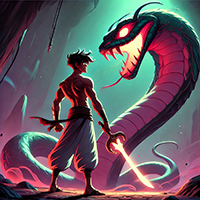
"Will it not call for attention with such a large following?" asked Dumu Numa. "Wouldn't it have been better if we had done the burial in secret?" "Of course not," Aea replied. "An attempt to conceal it would only arouse suspicion. This is a perfectly normal burial." "But for me, her son, to go into the morgue and stay there when the door closes, won't it seem conspicuous?" objected Dumu Numa. "Maybe it will for some, but they won't think much of it. Besides, you won't be there very long." "I won't?" Dumu Numa asked in surprise. "Won't it take days or moons to do such a task?" "For you, it will indeed feel like an eternity, and your trials will leave you utterly spent. Yet for us, still among the living, but a fleeting moment will have passed." Now, in the very instant when Dumu Numa stood on the threshold of his trials, the courage failed him. He knelt before the high priestess. "Superior Mother," he said. "I feel fear." "And rightly so," she replied. "To do otherwise would be folly. Your journey will be fraught with peril, yet your efforts shall yield great rewards." When the pallbearers came in, he stood composed. He followed them to the house of the dead with his head bowed. But he refrained from tearing his clothes, as was the custom. They marvelled at his equanimity but did not blame him for it. When the door was closed behind him, he squatted beside the stretcher and took his mother's hands in his. Although the sun shone down through the foliage of the roof, the room was instantly filled with a grey light. Not black, but a sad grey darkness. Hand in hand they, the hero and the mother, stepped through a silky screen. Before them lay a vast landscape, and two roads led through a dense undergrowth of grey, tall and withered shrubbery. A sharp, pointed mountain ridge could be seen far behind. In front of them stood the gate-keeper. He was tall and broad and mighty. Twice as tall as Dumu Numa, he loomed over the two figures. He leaned on a solid spear as tall as himself. His body was covered in horn-like armour with countless spikes sticking out. His lipless mouth bared his teeth, an ominous light shone behind his eye sockets, and horns protruded horisontally from both sides of his head. "This is the entrance to the realm of the dead," he thundered. "No living has access." Before Dumu Numa could react, Ninedinni answered: "You know who I am, and you shall not deny me access. By my side stands my son, the future ruler of the reunited kingdom of Ishis. It is beyond your power to deny him the enactment of the quest he has chosen, though uncertain the outcome may be." He bowed to Ninedinni. "Venerable madam," he said, pointing to the road to the left. "It is an honour to me." And pointing to the right road, he said to Dumu Numa: "I see that your errand disregards all customary procedures. May you not lose your way." As Dumu Numa took the first step, the landscape dissolved into shadow. Vegetation disappeared, leaving only barren, rocky ground. Before him stretched a river, vast and silent, the water inky black and smooth as glass. The air was thick with the tang of iron, and there was no sign of a bridge, a ferry, or a path forward. He knelt at the edge, peering into the depths, when a serpent with the face of a beautiful woman rose from the water, her scales shimmering faintly. She smiled, her voice a silken whisper. "You can't go back," he heard her say. Although she whispered, her words echoed from many sides. "I don't intend to," he said. "But how do I cross the river." "You could swim," she suggested, with the sweetest smile. "I could swim," he repeated to himself, absorbed in thoughts. His words fell to the ground like dust. The figure made a sudden movement, splashing water on him. "Are you just going to sit there?" she asked teasingly. "Come into the water to me." "I don't think I can swim that far," he declared. "Will you help me?" "Oh, but your clothes will get wet," she replied. "Take them off. I would like to see you naked." He hesitantly removed his clothes. "You’ve come far, hero. But here you must submit. Take my hand, and I’ll carry you across." Her extended hand glistened with water. Dumu Numa hesitated. He rembered the old man at the gate. His voice echoed faintly in his memory: 'You must be willing to let go of all you carry.' But could he trust her? He stripped off his armor and clothes and put his helmet on the ground, as if obeying some unspoken command. He carried only Ushbar and his shield strapped to his back. The coolness of the water immediately numbed his limbs. But then he felt the snake wrap around his body, and a pleasant drowsiness overcame him. "What has become of your manhood pride," she whispered mockingly. "Let me take care of it." He felt an incipient erection, but he instinctively fought it off. If he yielded, he feared, she would never let go of her grip, and he would remain in the gently flowing water with the goal of his journey still far out of sight. Sensing this, she reacted with rage. Her snake body was strong, and he was thrown around. Thus, he discovered that the water was not deep. He could touch the bottom. "You won't take my pride," he spat. Summoning his last reserves of strength, he plunged Ushbar into her body, cleaving her in two. Her scream echoed endlessly in the cavern. Exhausted, he crawled onto the far bank, his breath ragged. The river faded behind him, and his journey continued. With her screams hanging in his ears, echoing throughout the cave, he stepped out of the treacherous water and onto the far bank. He was naked, but losing his clothes was only the first loss he was going to suffer. Dumu Numa found himself in a vast cavern of crystal walls and twisting paths. Each turn showed reflections of himself—some larger, some smaller, some twisted into grotesque forms. Shadows flickered, dancing in the mirrors, each more unsettling than the last. As he walked, he grew increasingly confused. Each reflection spoke in riddles: 'Are you the man they say you are?' 'Would you fight for glory or survival?' 'Do you even know why you’re here?' One reflection taunted him: 'Turn back. You can’t win. The Goddess herself will abandon you.' Another whispered: 'The crown will devour you, prince. Is that what you desire?' He felt the old man’s words press on his mind. 'You shall cast away even yourself if you must.' Finally, he reached for the closest mirror and struck it with Ushbar. The shard that broke off reflected him as a naked, vulnerable boy. He took it in his hand and whispered, "I am Dumu Numa." The maze dissolved into darkness, and he moved forward. A great fire blazed ahead, the heat intense and unbearable. The flames danced, forming shapes of people he knew—friends, comrades, family. He saw Ishbi, his childhood companion, consumed by the fire. His mother stared back at him through the flames, her face sorrowful. "Come into the fire," a voice commanded. It was his own, yet not his own. "You must burn away your regrets if you are to pass." The flames beckoned, but his legs felt heavy. He clutched his sword, trembling. The fire roared louder, and his mother’s voice called to him: 'If you love me, come.' His heart broke. He screamed and stepped into the fire, expecting agony—but instead, felt only a cold emptiness as the faces disappeared. The flames died down, leaving nothing but ashes and smoke. He had passed through regret, but the pain lingered in his chest. Emerging from the ash-choked cave, Dumu Numa encountered a towering dragon. Its scales shimmered like molten gold, and its eyes burned with contempt. "Who dares disturb my domain?" the dragon roared. "You reek of ambition, mortal. Tell me, who do you think you are?" "I, Dumu Numa, am on a quest to fulfil my destiny," Dumu Numa said. "I have lost my way. Will you show me which way to go?" The dragon sneered. "Your destiny? What arrogance. You’ll fall as countless others have before you. Your pride blinds you. Don't you know this place is wild and perilous?" "I have told you my name, now tell me yours," said Dumu Numa, ignoring the dragon's words. "Indeed, the pride and the folly in the children of mankind. Never accepting their limitations," the dragon said, shaking its head. "But I'll tell you my name. I am Belzar. Maybe you know me?" "And how should I know you?" "Am I not the one who famously conquered a host of rebellious gods? Oh, the songs that have been sung about it, filling countless tablets with what has been and what will be. Are you really that ignorant?" "I make my own songs," Dumu Numa said proudly. "And did your precious tablets not mention that this little man would cross your path and maybe change your destiny?" "You think a lot of yourself," Belzar scoffed. "Can you vouch for it?" "Why would I bother? You mean nothing to me. Now, tell me the way out of here." Belzar jumped down and stood before Dumu Numa. He pointed with his tail and said: "With pleasure. That way. But first, you have to pass me." "You'd better move, then, don't you think?" The rumbling started again, and Balzar's eyes began to glow menacingly. Smoke emanated from his nostrils. The beast struck, its tail sweeping the ground, and flames erupted from its jaws. Dumu Numa held up his shield protectively and raised Ushbar. "I don't want to fight you, but I will if I must," he said. "Very well," said Belzar. "Be ready to meet your end." "You don't scare me. I'm not afraid to die." "Then die you verily shall." A raging furnace nearly knocked off the legs under Dumu Numa. He could feel the heat through the shield. He jumped back and to the left to be able to strike with his right hand. He hid behind a stalactite. As Belzar aimed the flames at the stone formation, Dumu Numa leapt forward, and he now found himself close to the dragon's heart. His sword arm was free. He thrust it forward. Any other sword would have bounced off the dragon's scales, but Ushbar went deep. With a scream, Belzar turned on his attacker. Despite his large body and despite being wounded, he moved with frightening agility. He moved from stalactite to stalactite, making the dragon follow him. When he sensed the dragon was getting weaker, Dumu Numa finally chose to confront him face to face. He pressed his shield with all his might against the flames, advancing slowly. The heat became so strong that he had to let go of the shield. Leaping to the left, he threw the shield to the right, and with Belzar instinctively following the movement, Dumu Numa was once again in a position to deliver a decisive blow to the dragon. Thick blood and a suffocating stench emanated from the wound. The dragon's body twitched convulsively. As he fell, he whispered, "Beware, hero. Pride will claim you in the end." Dumu Numa, leaning on his sword, looked down at him, not glad but sorrowful. "I told you I didn't want to fight you," he said. "Now, live if you may. I must be going." The dragon's body disintegrated into gold dust, leaving the path ahead open. High above, the cavern opened to a sky of shifting, storm-tossed clouds. From the heavens descended a great eagle, its wingspan vast enough to blot out the light. Its eyes burned like coals, piercing and accusatory. The eagle spoke without words, its gaze searing into Dumu Numa's soul. Every failure, every flaw, every moment of doubt was laid bare. He fell to his knees, trembling. "I claim not to be perfect," he cried. "I am not without sin. But I fight for a cause greater than myself." The eagle screeched, and the sound echoed like a thousand screams. Then, as if satisfied, it took flight, leaving behind a single feather. He took it and placed it in his hair. Without knowing where he was going, he kept moving, guided only by instinct. He was completely exhausted. What other challenges lay ahead? And what would he find at the end of this path? Apparently, his mother. She stood in the distance, reaching out to him with open hands. She looked younger than he remembered her in years. She was a light in the darkness. "I didn't think I'd meet you here," he said. His voice almost broke with emotion. "Would I ever fail you?" she asked. "But I thought we went our separate ways and that we would never meet again," he said, slowly approaching. "I could never leave you like this," she said caressingly. "Look at the state you're in. Come closer and let me ease your pain." He longed so much. How could he resist? But up close, he saw her change. On her back, she grew wings; they were huge, and a fowl stench emanated from them. Her beloved face grew a hooked beak of a bird of prey. Eyes, black as the night, tried to hold his gaze. 'Go away,' he thought. No more. The demon did not go away. Its powerful beak dug into his flesh until he was desperate with pain. Just like he had previously lured Belzar around until the point of exhaustion, likewise he himself was now chased by the bird woman until any fibre in his body ached. With one last superhuman effort, he flung Ushbar through the air and hit the demon deep into her bosom. She fled with an angry scream, but the sword remained lodged in her chest. There now! He was defenseless. Whatever attacked him, he would not be able to defend himself. He had no weapons, and he was weak. Too weak to even get up from the rock on which he sat, disheartened. Before him stood a twisted black tree, its branches sharp and skeletal. Creatures emerged from the shadows—grotesque beings with scorpion tails, spewing a luminous substance. It stung and burned when it hit his skin. He sensed more than he heard their rhythmic chanting in an ancient tongue: "Hang him up. Let him rot." Many hands grabbed him and pulled him towards a tree whose bare branches stood out black against a grey background. "You must sacrifice yourself," the shadows hissed. "Hang here. Rot here. Only then will you be free." He was bound and hung upside down, his blood dripping to the ground. His body screamed in agony, but his mind drifted to the old man’s words. 'You must be ready to throw everything away—even yourself.' It seemed easy now. Dark words were planted in his mind. Without resistance, he let himself drift among ominous shapes. He dreaded nothing, sensed only a defeatist devotion to whatever might come. "I am nothing. Take what you will," he whispered. Eventually, even the shapes of the shadows dissolved, and he lost consciousness. Unable to put it into words, he felt freed, relieved of any burden. He did not cherish being alive, for he had no consciousness of existence. He did not fear death, for he did not know what it was. As his vision dimmed, the shadows vanished, and he fell to the ground, unbound. The tree burst into flames, its ashes scattering on the wind. There, there! Exhausted and broken, he saw a flickering light in the distance. He crawled toward it, each movement agony. The light grew brighter, and a figure emerged—a woman crowned with flowers, radiant and serene. "My child," she said, her voice filled with warmth. "You have walked through shadow and flame. You have cast away everything, even yourself. Rise now, for you are renewed." She lifted him, and he looked around him. And she showed him all things, animals and plants, and she gave them names. "Look," she said. "I give all this back to you. It's yours, and you've earned it like never before." And she told him his story, and she breathed her spirit into him. "I am," he said in wonder. "You certainly are, my prince," she smiled. "Now rest a bit before you resume your commitments. Your journey is not yet over." Clad once more in his clothes and weapons, he stood tall. The eagle’s feather in his helmet, and Ushbar gleaming with a light that was now its own. "I am ready," he said. "Then go," she said, her voice echoing as she faded into the light. "Seek the Mashel." Ishis had gone, left him alone, bent over his dead mother. Only a few minutes had passed. The soft daylight shined through the roof's foliage. Pale but composed, he left the house of the dead and joined Aea and the rest of the townspeople. |
|||
| Copyright © 2025 John Hyldgaard | Back | ||