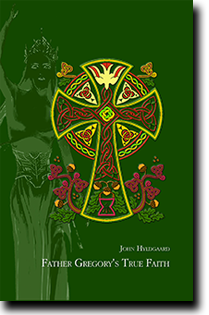
Father Gregory's True Faith |
|
|
Father Gregory's True Faith is a historical tale with an element of fantasy from an area and a period that is rarely illuminated in literature. In the year 585 a.d., we find two Irish monks in Frankish-dominated Gaul. Gaul, as part of the Roman Empire, has been Christianized for hundreds of years, but Christianity is primarily a religion of the ruling class, and monasticism is limited to the larger cities. The two monks, Gregory and Amatus, have been sent out to rectify this relationship. They are well received by the two currently reigning kings, Guntram and his young nephew Childebert II, and are assigned an area in a remote area. They also make a fruitful acquaintance with the contemporary historian and bishop Grégoire de Tours, the records of whom form the basis of some of the actual events that are part of the narrative. Gregory succeeds by virtue of personal qualities and by his ability to speak, so that the audience understands it, to win a large part of the local population for his cause. Among other things, with the help of a local Frankish nobleman, a monastery is established, and over a number of years, it is going to be an established part of the local area. But the encounter with the ancient religion has a fatal significance for Gregory's otherwise rock-solid faith. An ancient manuscript, as well as a pagan fertility goddess and an ancient female shaman, shake him in his faith, and he undergoes a spiritual transformation from the narrow Christian faith to something more comprehensive. He eventually feels compelled to leave his life's work and join the pagan goddess, who for him comes to represent the specifically female. |
| Copyright © 2022 John Hyldgaard | Back |